Fish Report for 1-23-2026
Mild weather, surfcasting success
by Allen Bushnell
1-23-2026
Website
Mild weather and calm seas resulted in an uptick of positive results for anglers fishing the Monterey Bay this week. Santa Cruz’ Bayside Marine owner Todd Fraser encapsulated conditions well, reporting, “The water was flat calm all day. The anglers caught a few halibut between the South Rock and Natural Bridges in 90 feet of water. The crab fishing is getting better in 200 feet of water. The sand dab anglers found some nice schools near the Soquel Hole Canyon. The perch fishing is still great.”
The early showing of halibut during January is unusual, but not unheard of. This may be a year where we can start looking in earnest for the big flatfish in March, rather than April or May. Diver’s reports from Monterey, near the Coast Guard Pier note the presence of a few legal-sized halibut in the shallows, along with “a bunch of juveniles.”
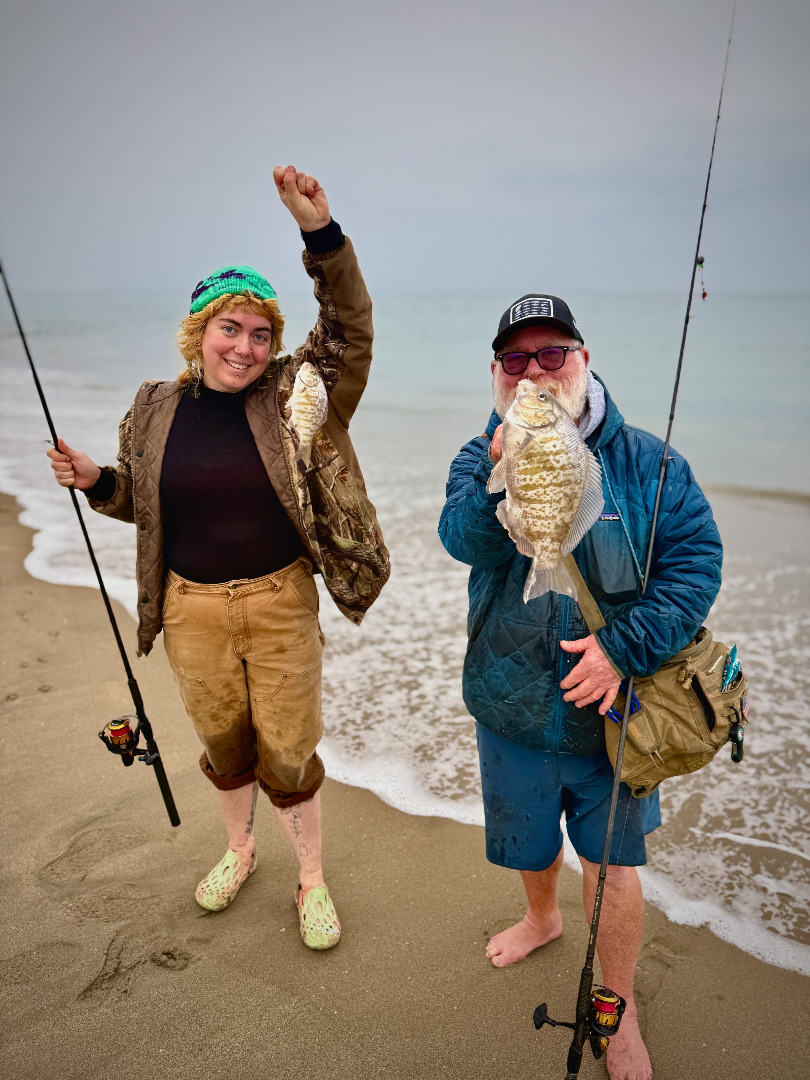
After a long spell of less than ideal weather conditions, surfcasting is starting to take off. The broad beaches from Manresa down to Seaside are showing decent structure, with sand points, rip currents and deep troughs parallel to the beach. Most surfcasters prefer to fish for perch and striped bass when a high tide coincides with sunrise or sunset. High tide means deeper water pockets are closer to the beach. It’s these troughs and “holes” that most often attract feeding perch and roving striped bass.
In the Monterey Bay area, we get wind almost every day. Early mornings can be very still, and sunset evenings often features a gentling of the winds that have blown all afternoon. It is just an educated guess on our part, but the surf fish seem to be more active in lower light conditions. This means dusk and dawn of course, but also includes overcast, cloudy or foggy days. Remember, surfperch and even the large stripers are potential prey as well as being predators themselves. Lower light conditions decrease their visibility to other fish or mammals that want to eat them. We believe lower light can foster a more aggressive bite as well. If the food item for our target fish is only visible for a shorter length of time and a closer proximity, our target fish is more likely to strike quickly. For us as anglers, the result can be slam-bang hookups. Which, to quote Carl Spackler, “is nice.”
Surfcasters looking for the biggest perch may want to try concentrating on the closest trough to the beach. Just behind the shorebreak, there is often a gully of deeper water. Larger fish are likely to hunt in that food-rich environment, and the larger fish are strong enough to handle the whitewater tumult and heavier currents. With kicked-up sand the visibility is lower, and that can encourage aggressive hits as mentioned above. Using larger swimbaits, stickbaits or small shiny Kastmasters or Krokodile spoons can be very productive for both perch and striped bass. You may catch fewer perch using the larger lures, but they are likely to be the bigger models.
< Previous Report Next Report >
< Previous Report Next Report >
More Reports

1-16-2026
Since the atmospheric river storms passed through recently, we have been blessed with some beautiful conditions on Monterey Bay, with...... Read More

1-9-2026
Anglers around Monterey Bay enjoyed a few very nice fishing days as the 2025 rockfish season eased to a close....... Read More

Website Hosting and Design provided by TECK.net