Drought, dams puts salmon on the brink
Drought, dams puts salmon on the brink
September 18, 2015
Los Angeles Times
Last summer, a narrow, rock-rimmed stretch of the Sacramento River near Redding, Calif., turned into a mass graveyard for baby salmon.
Upstream releases of water from Shasta Dam were so warm that virtually an entire generation of endangered winter-run chinook (“winter-run” refers to the season when the adults enter freshwater) was wiped out. The eggs never hatched or, if they did, the emerging young soon died.
A similar disaster could unfold this year. And if the drought drags on for another year or two, wild populations of some of California’s most prized fish are likely to vanish.
“We’re going to be losing most of our salmon and steelhead if things continue,” said University of California at Davis professor emeritus Peter Moyle, a leading authority on California’s native fish. Also in danger are the long-suffering delta smelt, whose numbers have plunged to what he called “the last of the last.”
“It would be a major extinction event,” Moyle warned.
Climate models suggest many Western states will face longer and harsher droughts in the decades to come.
The drought’s toll on California has been measured mostly in terms of idled cropland, dried-up domestic wells and brown lawns. Less visible but more devastating has been damage to native fish that struggle for survival in the best of times.
Four years of drought — and the accompanying relaxation of environmental standards by state regulators — have compounded the harm of dams and diversions that long ago thwarted fish migration and destroyed habitat.
Spawning winter-run chinook would never choose to hang out on the outskirts of Redding on a day when the city baked in 111-degree heat. They would prefer to swim in the cold, spring-fed waters of the McCloud and other Sacramento tributaries to the north.
But for about 70 years, those historic spawning grounds have been out of the salmon’s reach, blocked by the towering concrete face of Shasta and the buttresses of its smaller sibling, Keswick Dam.
“This is as far as fish can go on the Sacramento main stem,” fishery biologist Ryan Revnak said as he steered his boat upriver toward Keswick, which regulates flows from Shasta’s hydropower plant.
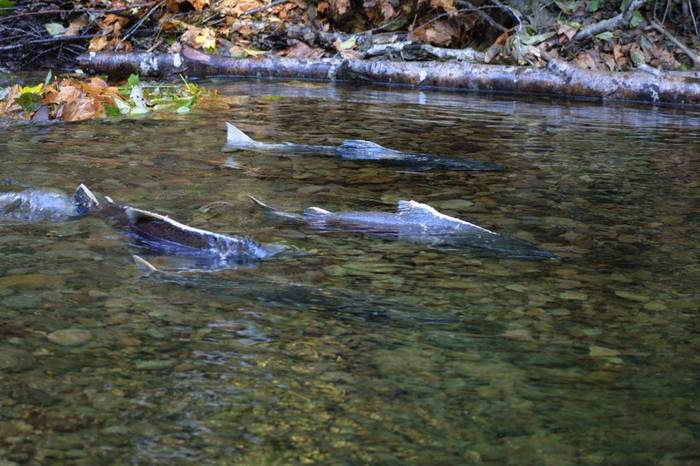
Revnak, who works for the Pacific States Marine Fisheries Commission, pointed out the gravel beds where the salmon built their nests, called redds. A female, close to death after laying her eggs, hovered in shallow water near the bank. A dead male, his procreative work also done, floated by.
Salmon eggs and emerging fry need cold water to survive. The river temperature shouldn’t top 56 degrees. Last year in the spawning grounds below Keswick, it climbed above 62 degrees. Only 5 percent of the 2014 brood stock lived.
Dam troubles
The U.S. Bureau of Reclamation, which operates the dams, had miscalculated the volume of cold water in Shasta and didn’t have enough to maintain the proper river temperature. The problem wasn’t just that the drought had slashed runoff that fills the lake; the computer model used to predict cold water storage was wrong.
Federal agencies are trying to avoid a repeat this year by rationing Shasta’s cold water releases so managers don’t run out while the eggs and young develop over the next few months. But stretching the reserves of cold water has meant lower releases this summer, nudging up the river temperature a degree or two during peak spawning.
And long bouts of 110-degree days in Redding could further warm the river. “There’s a lot of uncertainty” in the plan, said Maria Rea, an assistant regional administrator for National Oceanic and Atmospheric Administration Fisheries. “I don’t have a high confidence that it will work.”
If it doesn’t, a complex near the base of Shasta Dam could be the winter run’s last hope.
One wall of a building at that complex, the Livingston Stone National Fish Hatchery, is lined with incubation trays holding hundreds of thousands of winter-run eggs and young in different stages of development: fertilized eggs, eyed eggs that resemble pink jelly beans with two miniature fish eyes, sac fry feeding on their yolks, tiny infant fish that wiggle like a mass of gray worms.
Tanks of juveniles fill the main building. Adults are held in outside tanks, enclosed in zippered tents so they can’t leap out.
Livingston is a conservation hatchery, opened in the late 1990s to maintain a genetically diverse population of wild winter-run salmon. In a typical year, the hatchery traps up to 120 returning adults in the Sacramento and spawns them with the precision of a champion horse breeder.
The average female lays 5,000 eggs, which are divided into two or more sets. Each set is fertilized with sperm from a different male whose DNA has been analyzed to avoid inbreeding.
The tanks and egg trays are bathed with circulating water released from the dam. Last summer, hatchery managers had to use chillers to maintain the proper temperature. They may have to do the same this year.
To counter the drought losses, Livingston has ramped up production. The hatchery team is spawning 300 adults this year and, come winter, will release twice as many juveniles into the Sacramento as it normally does.
But even in good years, only a tiny fraction of those hatchery salmon survive to adulthood and return to spawn. And if river conditions aren’t right, their offspring will perish.
Facing that grim scenario, Livingston last year established a captive brood stock, which the hatchery will raise for the entire three-year life cycle of the fish. If worse comes to worst, it will function as a fall-back population. “You can’t give up trying,” said Assistant Hatchery Manager John Rueth.
In the meantime, he added, “All of us keep praying for this massive El Niño.”

Website Hosting and Design provided by TECK.net