Water turnaround needed for SJ salmon turnaround
Water turnaround needed for SJ salmon turnaround
August 18, 2015
Fresno Bee
By Mark Grossi
More than six decades after their deaths, the San Joaquin River and chinook salmon slowly are coming back to life in an unprecedented, hard-fought revival. But raising the dead here is not the real magic.
The trick in restoring this dried river is making water turn around and run uphill to be used on farms. It already has happened in the 6-year-old restoration, but it’s about to become a lot tougher and even more political than before.
Until now, some water released from Friant Dam for this project has been collected at Mendota Pool in west Fresno County, a point dozens of miles from the end of the restoration project. It’s not complex. The river simply doesn’t flow regularly beyond the pool.
But when the river finally refills beyond the Mendota Pool in the future, federal officials may have to contend with statewide water fights in the controversial Sacramento-San Joaquin Delta. In other words, the water may wind up going elsewhere.
“We expect our ability to recapture to decrease in the future,” says program manager Alicia Forsythe of the U.S. Bureau of Reclamation, which is leading the project.
Officials say they’ve captured and returned 40% of the restoration water released from Friant Dam since 2009. In environmental and bureaucratic circles, that’s a success story. Among east-side farmers, it’s not so much.
Returning water to farmers in this $1.5 billion river restoration has not been as high-profile as jump-starting North America’s southernmost salmon runs. The fish story is pretty compelling – nobody has restarted dead salmon runs in a dried river this far south in North America, scientists say.
But 15,000 east San Joaquin Valley farmers rely on river water for irrigation along one of the nation’s top citrus belts. They are watching closely as federal agencies consider how to further plumb the state’s second-longest river, which already is extensively altered.
Federal leaders are taking comment this month before creating alternatives for downstream capture and return of river water. By 2018, they hope to have a formal plan and begin building possible projects, such as pumping plants and canals.
Why? Farm water district leaders say little money is being spent on returning water, compared to rebuilding the river channel and salmon runs. In the latest budget revise, recirculation gets about $100 million out of the $1.5 billion total.
“The whole idea of co-equal goals of restoring the river and returning water to farmers has been a joke,” says Tulare County farmer Mark Watte.
But the returned water is probably a lot more than farmers would have gotten if the restoration lawsuit had not been settled, say environmentalists. The legal action, filed by the Natural Resources Defense Council in 1988, was going badly for farmers when they reluctantly settled in 2006.
In addition, farmers have been offered a lot of water at rock-bottom $10-per-acre-foot prices, says NRDC senior scientist Monty Schmitt, who has been closely following the restoration for many years.
Many farmers sold the water, using the extra money to improve water systems. In places where groundwater recharge is possible, some water was used to bank in the underground.
“These are real and significant amounts of water,” Schmitt says. “The water has reduced and avoided the impacts of the restoration.”
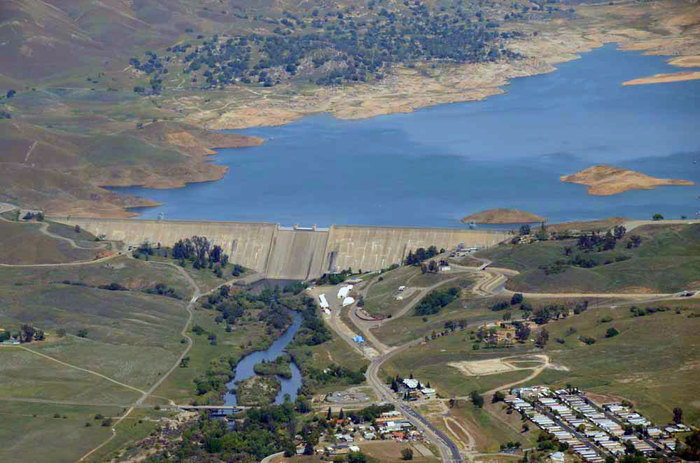
After Friant Dam was finished in the late 1940s, the river’s water was used to bolster east Valley farming, which stretches over 1 million acres from Chowchilla to Bakersfield. But contrary to law, federal officials did not protect salmon runs when the dam was built.
Environmentalists waited decades for federal water contracts to come up for renewal before getting the opportunity to challenge the decisions made for Friant Dam. After another 18 years of legal fighting and a difficult compromise, the restoration began in 2009 with anxious farmers and environmentalists watching.
Environmentalists found improvements almost immediately, saying water releases from Friant Dam began to refill depleted underground water supplies, helping nature, surrounding agriculture and small cities, such as Mendota.
In wetter years, the restoration can use nearly 200,000 acre-feet of water – about 20% of the river water farmers had been using. Farmers say the restoration would cut enough water supply to wipe out thousands of profitable acres and start a steep decline in the east-side economy.
But the drought is overshadowing everything. Restoration water flows stopped completely for the drought last year and haven’t resumed. Over the last two summers, east Valley farmers haven’t gotten any river water, either.
At the same time, farmers haven’t forgotten their opposition to the restoration in general and the return of salmon in particular. Salmon, a cold-water fish, may not survive in this part of California as the climate warms, they say.
1 million acres of farmland from Chowchilla to Bakersfield relies on San Joaquin River water
Farmer Kole Upton, who helped negotiate the settlement a decade ago, says the government doesn’t have the money for the massive restoration project.
He adds that environmentalists have undermined the water-return aspects with their defense of the delta, which he says takes more water from Valley farming and makes it tougher to return the river water.
Upton says when environmentalists signed the river agreement, they committed to helping farmers recover water losses in the restoration.
“It was like buying a car,” he said. “You think you bought a Cadillac, but they deliver a used Volkswagen.”
Arguments aside, the Bureau of Reclamation has a tall task ahead. The agency must turn water around after it passes through the 150 river miles of restoration. That means officials will have to divert it from the river somewhere beyond the place where the Merced River meets the San Joaquin.
In past discussions, officials have talked about intercepting the water before it gets to the delta and sending it to San Luis Reservoir in western Merced County.
In the past few years, some water in the reservoir has been made available for the east-side farmers, who are part of the Friant Division of the Central Valley Project.
Some Friant districts have made swaps with other districts that can both use the water from San Luis Reservoir while providing the east-siders a similar amount from a more local source.
There also is the possibility of sending water down the California Aqueduct to the Cross Valley Canal near Bakersfield. But that can be expensive because the water must move farther.
Says bureau leader Forsythe: “We really leave it up to the individual Friant contractor to determine how best to manage the recapture water as each district is unique. Reclamation does its best to assist them any way we can.”

Website Hosting and Design provided by TECK.net